
Moroccan Mint Tea (Atay) — The Ritual, the History, and How to Make It at Home
Originally published May 30, 2011, updated April, 2026.
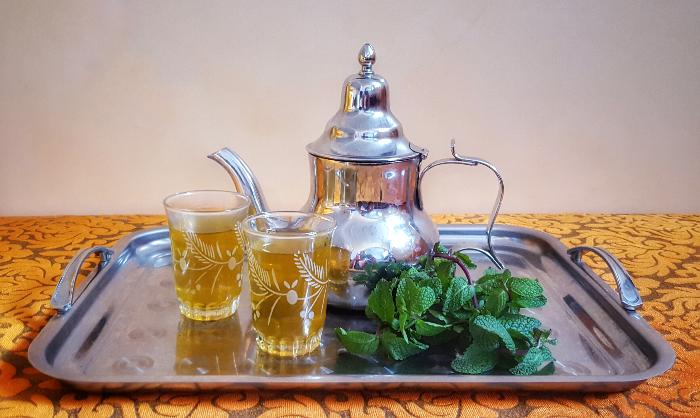
The moment we landed in Morocco, our Airbnb host introduced us to our first cup of Moroccan Mint Tea. I was immediately in love because most of the countries we visit are coffee forward. And I’m not a coffee drinker. I love a good tea. Not water, not coffee… tea. Warm, sweet, fragrant Moroccan mint tea in a small glass, poured from what felt like four feet above our heads.
That was our welcome. And honestly? It set the entire tone for the trip. Morocco is a country that takes its tea seriously. What I didn’t fully understand until we were actually there is that Moroccan mint tea… called atay is so much more than a drink. It’s an act of hospitality. It’s a ritual. And once you learn how to make it properly, it’s one of those recipes you come back to again and again.
The Story Behind Our Love of Moroccan Mint Tea
I’ve always been a tea drinker. Never gotten into the after taste that coffee leaves in the mouth. The hubby is fully devoted to coffee, so up to that point in our travels, most countries were serving him his love language and leaving me with mediocre hot water bags. Then we got to Morocco, and suddenly I was the one who didn’t want to leave (more of our adventures and my chocolate pancake recipe here).
This isn’t your ordinary mint tea. It’s not a teabag and some fresh mint thrown in a mug. Moroccan mint tea combines two of my absolute favorite flavors — green tea and mint — in a way that feels considered and ceremonial every single time.
Our Airbnb host in Morocco was a man named Aziz. He was generous with his time, his stories, and his tea. He made us pot after pot during our stay and eventually taught David how to do it himself. It’s traditionally more of a man’s job in Morocco… women make tea too, but the ritual of it, the competitive pouring, the showing off… that tends to be the domain of the men. Which means the hubby is now my official Moroccan mint tea-making person. He takes his responsibilities very seriously.

The Cultural History of Moroccan Mint Tea
So, like most tea culture including the British, tea was not originally Moroccan. The gunpowder green tea at the heart of atay actually came from China, introduced to Morocco by British merchants in the 1860s during a period when European ports were blocked and traders needed new markets. The Moroccans took that Chinese green tea and combined it with their native spearmint and sugar tradition… and the result became the national drink of a country that wasn’t even the tea’s homeland.
By the 20th century, tea had become so embedded in Moroccan culture that it fueled diplomatic rituals, cemented business deals, and defined the rhythm of daily hospitality. You don’t refuse Moroccan mint tea. It would be like refusing someone’s hand and is considered rude.
The three-glass tradition is one of the most beautiful parts of the ritual. There’s a Moroccan proverb that explains it perfectly:
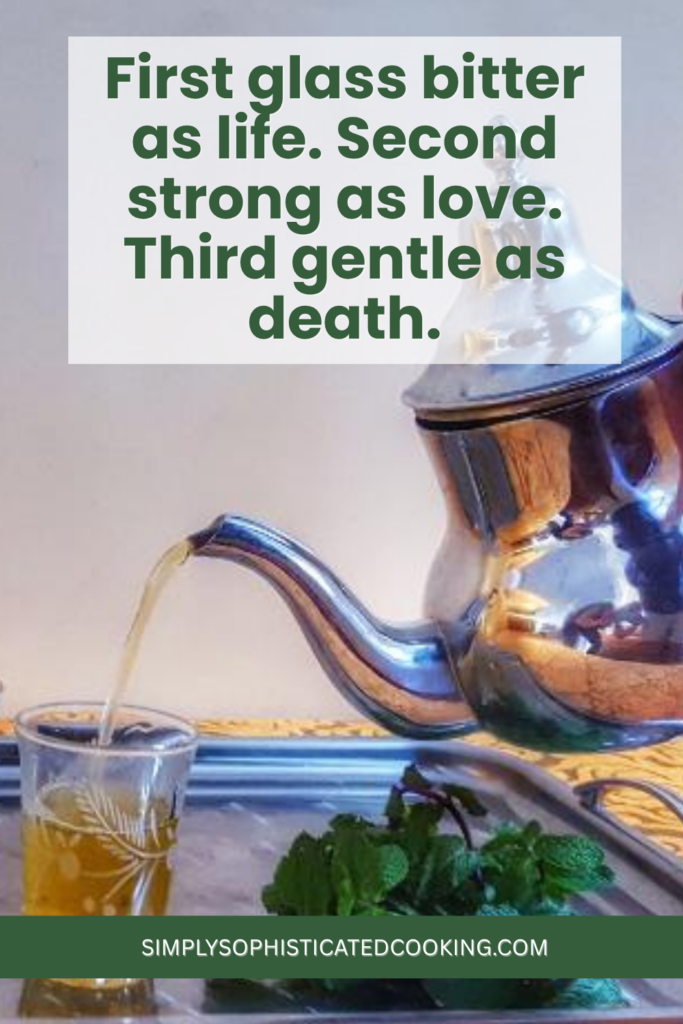
“The first glass is as bitter as life, the second glass is as strong as love, the third is as gentle as death.”
Each glass comes from the same pot, which deepens and mellows as it steeps. The first is the most intense, the last the sweetest and most delicate. Aziz explained this to us on our second evening there, and we sat with our three glasses and took it slowly.
The ritual of the pour matters too. Pouring from a great height, sometimes three or four feet above the glass, aerates the tea and creates that signature creamy foam on top. It also distributes the sugar that’s settled through the pot. The higher the pour without spilling a drop, the more skilled the tea maker. We watched some Moroccan men pour from fully standing height above the glass without losing a drop. David’s best is a solid two feet. I’m his proud audience.

Aziz’s Version: Artemisia and What Makes Each Recipe Personal
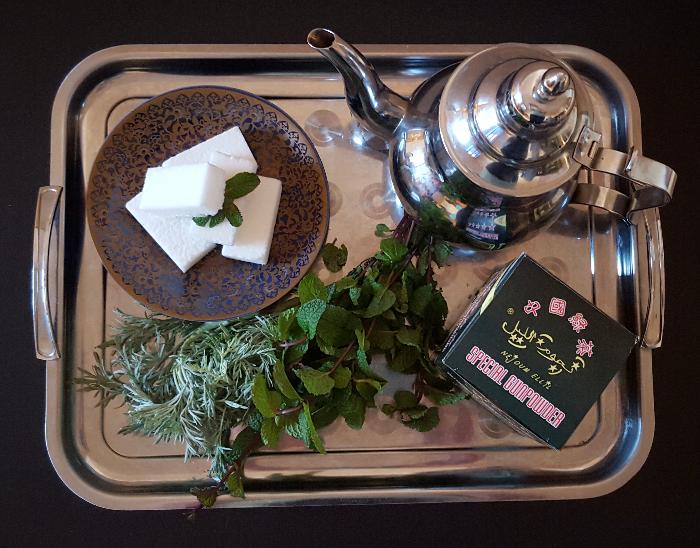
Every Moroccan has their own atay recipe. The base is the same… gunpowder green tea, fresh mint, sugar… but from there it gets personal. Some use more mint, some less. Some add sage. And Aziz added Artemisia to his, a slightly bitter aromatic herb that’s traditionally used more in winter. It gives the tea a depth that I’ve never had in any other version… something warm and almost medicinal but in the best way.
We added Artemisia to ours too, following his lead. If you can find it, it’s worth trying at least once. Sage is easier to source in the US and gives a similar herbal warmth without the bitterness. In summer, some Moroccans use orange blossom or add nothing extra at all, letting the mint do the work on its own.
Aziz also introduced us to our first of many tagines and I shared his Beef Tagine recipe here.

Gunpowder Green Tea — What It Is and Where to Find It
The tea itself is a big part of what makes this recipe taste right. Gunpowder green tea gets its name from the way the leaves are rolled into small tight pellets before drying… the shape looks a bit like old-fashioned gunpowder shot. It has a stronger, slightly smokier flavor than most green teas, and more caffeine. If you’re sensitive to caffeine, just brew it weaker or drink less of it.
In Morocco and Portugal, I can find it easily. There are Asian and Indian markets where it shows up reliably. I actually picked up a box at an Asian market in Porto on a recent trip. In the States, your best bet is Amazon, where several good brands are available and easy to order. Look for loose-leaf gunpowder green tea rather than bags, the rolled pellets are important for both the flavor and the traditional brewing method. I’ll link what I use in the Recommended Tools section below.
If you absolutely cannot find gunpowder tea, a high-quality loose-leaf Chinese green tea is the closest substitute. The flavor will be milder but the recipe will still work.
The Brewing Ritual: Step by Step
Here’s the thing about making Moroccan mint tea, it takes a little patience. Not a lot. But it’s not a kettle-and-bag situation. The process is part of the experience.
You start by rinsing the tea leaves. Add them to your teapot, pour in a small amount of boiling water, swirl it around for about 30 seconds, and drain it off. This washes the leaves and tones down any initial bitterness from the gunpowder tea… a step most recipes skip and shouldn’t.
Then you add fresh mint, more boiling water, and let the whole thing come to a gentle boil on the stove top. After about five minutes, you add sugar and let it steep.
The last step is the mixing ritual. To distribute the sugar evenly through the tea, you pour it from height into a glass, then pour it back into the pot. You repeat this three to four times. Each pour aerates the tea, creates that beautiful foam, and fully integrates the sugar. This is also when you discover whether you have the steady hand of a Moroccan tea master or, like me, you’re grateful for the kitchen sink.
How to Serve and Enjoy Moroccan Mint Tea
Traditionally, you’ll drink three glasses from one pot, each tasting a little different as the pot deepens and the mint releases more flavor. The glasses are small and ornate. Part of the ritual is the beauty of the service.
At home, I serve it on a little tray with the teapot and small glasses when we have guests, because it’s genuinely one of the most impressive drinks you can bring out for people who’ve never had it. Something about the pour makes everyone lean in.
If you want to try an iced version in summer, brew the tea at double strength, let it cool, and pour it over ice with extra fresh mint. It’s not traditional, but it’s absolutely delicious and one of the best cold drinks I know for hot weather.
Moroccan tea pairs beautifully with almond-based sweets — briouat stuffed with almond paste, sesame cookies, or even just a good shortbread if you’re keeping it simple. Or drink it on its own, the way Aziz did, letting it be its own thing.
Do you have a memory of drinking tea somewhere that stopped you in your tracks? I’d love to hear it in the comments. And if you make this at home — whether you master the high pour or end up wearing half of it — please tell me about it.
Btw, got a bunch of fresh mint leftover? Use it to make delicious homemade falafel.
Recommended Ingredients & Tools for Moroccan Mint Tea
Here’s what makes a real difference when you’re recreating this at home:
Ingredients
- Gunpowder Green Tea — The non-negotiable ingredient. Look for loose-leaf gunpowder tea rather than bags — you want those small rolled pellets, not dust. Several good brands are on Amazon. The stronger, slightly smoky flavor is what makes this taste like atay and not just mint tea.
- Sugar Cones or Moroccan Sugar — In Morocco, tea is traditionally sweetened with tall white sugar cones that are chipped off as needed. You can find these on Amazon if you want the authentic version. Regular white sugar works perfectly fine and is what most of us will use.
Tools
- Moroccan Teapot — A proper Moroccan teapot isn’t just decorative — the spout shape and size is designed for that high pour. They’re not expensive and they make such a difference in the experience. Look for one in silver-colored metal, which is what you’ll see most often in Morocco.
- Moroccan Tea Glasses — Small, colorful, ornate. The kind of thing that turns an afternoon tea break into something that feels special. Totally optional but absolutely worth it if you’re going to make this a regular ritual.
We are a participant in the Amazon Services LLC Associates Program, an affiliate advertising program designed to provide a means for us to earn fees by linking to Amazon.com and affiliated sites. These links and other affiliate links like them do not cost you any extra when shopping but they do help us fund the creation of this site and publications.
Frequently Asked Questions About Moroccan Mint Tea
- What kind of mint is used in Moroccan mint tea? When we lived in Morocco, we learned that spearmint is used over peppermint because of peppermint’s intense menthol completely overpowers the delicate gunpowder tea leaves. Spearmint is much milder and sweeter, but you can use peppermint in a pinch. We just use less.
- Can I make Moroccan mint tea without a Moroccan teapot? Absolutely. Just use your regular brewing teapot or even a small saucepan. You won’t be able to get the high pour, but hey, it’s still good tea anyway you look at it.
- What does the three glasses tradition mean? It comes from a traditional Moroccan proverb we learned from the locals while living there that has to do with the strengthen of the tea. The first glass is as bitter as life, the second as strong as love, and the third as gentle as death. They all come from the same pot, but it has to do with how long the tea steeps. The flavor changes with each glass.
- Can I make Moroccan mint tea iced? Yep. It’s so delicious on a hot day, even if it’s not a traditional way of serving it. I make a large pot of it and let it cool down, then serve over ice and with a few fresh mint sprigs. Adjust the sweetness to your taste.
- Where can I buy gunpowder green tea in the US? Amazon is your most reliable option (search for loose-leaf gunpowder green tea). Or check your local Asian or Indian grocery market. That’s where we get it from in Portugal.

Moroccan Mint Tea (Atay)

Ingredients
- 3 cups water
- 2.5 tsp loose “gunpowder” green tea
- 3 tbsp sugar
- 8 sprigs fresh mint (approx. 6” long) washed
- 4 sprigs artemisia or sage if desired
Instructions
- You’ll need a working teapot, not a decorative one. Add tea leaves to the teapot. Set aside.
- Place water in a small pot and bring to a boil.
- Pour ½ cup of boiling water on the tea leaves. Allow to sit for approximately 30 seconds to a minute, then swirl around and drain out the water, reserving the tea leaves in the teapot.
- Give the mint sprigs a good twist to bruise them and place into the teapot.
- Pour in the rest of the hot water.
- Place the teapot on the burner and bring to a boil. Boil gently for about 5 minutes.
- Add sugar to the pot.
- Remove teapot from the burner and allow tea/mint too steep for 5 minutes.
- To mix the sugar, pour tea from about a foot or higher above into a serving glass. Pour tea back into the teapot and repeat this process for 3 to 4 times. This part of the process not only mixes the sugar but also aerates the tea.
- To serve the tea, using the same high pouring method, forming creamy bubbles on top the tea.